Signing Info:
Transferred from: St Patrick's Athletic, 27/04/1982, £30,000
Previous Clubs:
St Patrick's Athletic
Debut:
13/11/1982 v Tottenham Hotspur (H) 1-0 (League Division One)
Farewell:
Transferred to Aston Villa, 08/1989, £450,000
Passed Away:
Biography
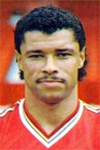
Paul McGrath is regarded as one of the finest defenders ever to represent Manchester United and the Republic of Ireland. Renowned for his exceptional reading of the game, calmness under pressure and remarkable technical ability, McGrath became one of Old Trafford's most admired players during the 1980s. Despite battling persistent knee problems throughout his career, he consistently produced performances of the highest quality and remains one of the club's most naturally gifted defenders.
Born in Ealing, London, on 4 December 1959 to an Irish mother and Nigerian father, McGrath moved to Dublin as a child. His footballing journey was far from straightforward, beginning in non-league football before joining St Patrick's Athletic. His outstanding performances quickly attracted attention from English clubs, and Manchester United secured his signature in August 1982.
McGrath made an immediate impact following his arrival at Old Trafford. Initially used as a midfielder before establishing himself in central defence, he displayed outstanding composure in possession, excellent positional awareness and an ability to read danger long before it developed. His versatility allowed him to excel in several roles, but it was as a commanding central defender that he became one of the First Division's outstanding players. His debut season proved to be a memorable one. McGrath was named the PFA Players' Player of the Year for the 1982–83 season, becoming one of the few defenders to receive the prestigious honour. His performances helped Manchester United finish strongly in the league before defeating Brighton & Hove Albion in the FA Cup Final replay to lift the trophy.
Under manager Ron Atkinson, McGrath became one of the cornerstones of an exciting Manchester United side that regularly challenged for honours during the mid-1980s. Alongside players such as Bryan Robson, Gordon McQueen, Norman Whiteside, Frank Stapleton and later Mark Hughes, McGrath helped establish United as one of England's strongest teams. Manchester United won a second FA Cup during McGrath's time at the club in 1985, defeating Everton 1–0 after extra time despite playing much of the match with ten men following Kevin Moran's dismissal. McGrath's calm defensive display was instrumental in helping United secure the famous victory at Wembley.
As the decade progressed, recurring knee injuries increasingly affected his career. Much of the cartilage in both knees had deteriorated, forcing him to adapt his game and carefully manage his training schedule. Despite these physical challenges, McGrath continued to perform at an elite level, relying on his intelligence, anticipation and impeccable timing rather than pace.
When Sir Alex Ferguson arrived as Manchester United manager in November 1986, McGrath remained one of the club's most respected senior professionals. However, Ferguson sought to rebuild the squad, and concerns over McGrath's long-term fitness ultimately led to his departure in the summer of 1989.
During his seven years at Old Trafford, McGrath made 199 competitive appearances and scored 16 goals. Although injuries prevented him from playing even more matches, his influence whenever he took the field was immense, and he earned the admiration of teammates, supporters and opponents alike.
Following his departure from Manchester United, McGrath joined Aston Villa, where he enjoyed arguably the finest period of his club career. Under Graham Taylor and later Ron Atkinson, he became one of the Premier League's outstanding defenders, helping Villa challenge for the title and winning the PFA Players' Player of the Year award for a second time in 1992–93. He later finished his playing career with Derby County before retiring in 1997.
Internationally, McGrath became one of the greatest players in the history of the Republic of Ireland. Winning 83 international caps, he represented Ireland at UEFA Euro 1988 and both the 1990 and 1994 FIFA World Cups. One of his most celebrated performances came against Italy at the 1994 World Cup, where he produced a magnificent defensive display to help Ireland secure a famous 1–0 victory over the eventual tournament runners-up.
Away from football, McGrath has spoken openly about his personal struggles, including alcoholism and the physical pain caused by his chronic knee injuries. His honesty has earned widespread respect and has inspired many people facing similar challenges.
Paul McGrath's legacy at Manchester United remains significant. Although injuries limited the number of appearances he could make, few defenders have possessed his combination of elegance, composure and defensive intelligence. Widely regarded as one of the club's finest centre-backs of the modern era, he remains a hugely popular figure among Manchester United supporters and one of the greatest footballers ever to represent both the club and the Republic of Ireland.