Debut:
25/08/1984 v Watford (H) 1-1 (League Division One)
Farewell:
Transferred to Bordeaux, 18/11/1988, £400,000
Passed Away:
Biography
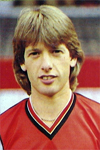
Jesper Olsen was one of the most naturally gifted wide players to represent Manchester United during the 1980s. Blessed with exceptional close control, pace and creativity, the Danish international thrilled Old Trafford crowds with his dribbling ability and eye for a defence-splitting pass. Although his time at United coincided with a period of transition for the club, Olsen became a fan favourite thanks to his entertaining style of play and his ability to produce moments of brilliance.
Born in Faxe, Denmark, on 20 March 1961, Olsen began his professional career with Næstved IF, where his impressive performances quickly established him as one of Denmark's brightest young talents. His reputation grew further after moving to Ajax in the Netherlands in 1981. Playing alongside future footballing legends, Olsen flourished in Ajax's attacking system, winning the Dutch Eredivisie and attracting interest from several major European clubs.
Manchester United manager Ron Atkinson secured Olsen's signature in the summer of 1984 for a fee of around £350,000. Expectations were high, and the Danish winger quickly demonstrated why he was considered one of Europe's most exciting attacking players.
Olsen made an immediate impact at Old Trafford. Operating primarily on the left wing, he possessed outstanding balance, quick feet and the confidence to take on defenders repeatedly. His crossing ability and vision made him an ideal supplier for forwards such as Frank Stapleton, Mark Hughes and Norman Whiteside, while his intelligent movement often created opportunities for teammates.
One of Olsen's greatest strengths was his unpredictability. Comfortable using either foot, he regularly drifted inside from the wing, combining with midfielders before accelerating past defenders. His flair brought excitement to Manchester United's attack, and he became an important member of Ron Atkinson's entertaining side.
The highlight of his Manchester United career came during the 1984–85 season. United made a sensational start to the First Division campaign, winning their opening ten league matches and appearing genuine title contenders. Olsen played a significant role in that remarkable run, providing creativity and width while contributing important goals and assists.
That season also ended with FA Cup success. Manchester United defeated reigning league champions Everton 1–0 after extra time in the 1985 FA Cup Final despite playing for much of the match with ten men following Kevin Moran's dismissal. Olsen's tireless work on the wing helped United secure one of the club's most famous Wembley victories and earn his first major honour in English football.
Olsen continued to be a regular under Ron Atkinson before working under Sir Alex Ferguson following his appointment in November 1986. Although Ferguson appreciated Olsen's technical quality, he was gradually reshaping the squad, and competition for places increased as the rebuilding process gathered pace. During his Manchester United career, he made 176 competitive appearances and scored 24 goals, while also providing countless assists with his creativity from wide areas.
In 1988, after almost 5 seasons at Old Trafford, Olsen was transferred to Bordeaux before a short stint with Caen.
Internationally, Olsen earned 43 caps for Denmark and scored five goals. He was a key member of the famous Danish side known as "Danish Dynamite," which captured the imagination of European football during the 1980s. He represented Denmark at UEFA Euro 1984, the 1986 FIFA World Cup and UEFA Euro 1988, helping establish his country as one of Europe's emerging football powers.
Jesper Olsen remains a popular figure among Manchester United supporters who remember the excitement he brought to Old Trafford. His willingness to take on defenders, combined with his elegance on the ball and creative vision, made him one of the most entertaining wingers of his era. Although his time at Manchester United lasted only four seasons, his contribution to the club's 1985 FA Cup triumph and his role in one of the most attractive United teams of the 1980s ensure his place in the club's rich history.