Debut:
20/10/1934 v Newcastle United (A) 1-0 (League Division Two)
Farewell:
Transferred to Swansea Town, 1938, £
Passed Away:
12/12/1967 (age 62)
Biography
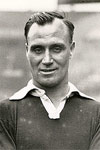
Thomas Charles “Tommy” Bamford was a prolific Welsh centre-forward who represented Manchester United between 1934 and 1938. A powerful and dependable goalscorer, Bamford spent four seasons at Old Trafford and helped United win the Second Division championship in 1935/36.
Bamford was born in Port Talbot, Wales, on 2 September 1905. Before entering the Football League, he played for Cardiff Docks, Cardiff Wednesday and Bridgend Town. His goalscoring ability eventually attracted the attention of Wrexham, whom he joined in 1929.
It was at the Racecourse Ground that Bamford established himself as one of the most prolific forwards in Welsh football history. He scored at an extraordinary rate for Wrexham and was the club’s leading goalscorer for five consecutive seasons. His finest individual campaign came in 1933/34, when he scored a club-record 44 Football League goals and 51 times in all competitions.
Bamford also helped Wrexham win the Welsh Cup in 1931, scoring twice as the club defeated Shrewsbury Town 7–0 in the final. He remains one of the most celebrated players in Wrexham’s history and is recognised as the club’s record goalscorer.
His performances earned him international recognition with Wales. Bamford won five senior caps between 1930 and 1933, scoring once. That goal came on his international debut against Scotland at Ibrox on 25 October 1930. Wales secured a 1–1 draw despite being forced to select an unfamiliar side after several Football League clubs refused to release their players. The team subsequently became known as “Keenor and the Unknowns”, after captain Fred Keenor and the relatively unheralded footballers who played alongside him.
Manchester United signed Bamford from Wrexham in October 1934, with his teammate Billy Bryant also moving to Old Trafford. Bamford made an immediate impression on his United debut against Newcastle United at St James’ Park on 20 October 1934. He scored after ten minutes to give United a 1–0 victory in the Second Division.
The Welshman scored consistently throughout his time with United. After registering nine league goals during his first campaign, he scored 16 in 27 league appearances in 1935/36 as United were crowned Second Division champions and returned to the top flight.
United struggled following promotion and were relegated at the end of the 1936/37 season, but Bamford continued to find the net. He scored 14 league goals during the campaign and was United’s leading goalscorer. One of his most memorable performances came against Derby County in September 1936, when he scored a hat-trick despite United suffering a remarkable 5–4 defeat.
Bamford remained an important member of the side during 1937/38. He scored another 14 league goals as United secured promotion for the second time in three seasons, finishing runners-up to Aston Villa in the Second Division. That achievement provided a fitting conclusion to his Old Trafford career.
In total, Bamford made 109 competitive appearances and scored 57 goals for Manchester United. His league record was 53 goals from 98 appearances, demonstrating the consistency that made him such a valuable centre-forward during a challenging period in the club’s history.
Bamford left United for Swansea Town in 1938 and continued scoring regularly during the 1938/39 season. However, the outbreak of the Second World War interrupted his playing career. By the resumption of regular competitive football, he was approaching 41 and subsequently retired from the game.
Following his retirement, Bamford returned to Wrexham and worked at a local steelworks. He died in Wrexham on 12 December 1967, aged 62.
Although particularly remembered for his remarkable goalscoring achievements with Wrexham, Tommy Bamford also made a significant contribution to Manchester United. His 57 goals, a Second Division championship and involvement in two promotion-winning campaigns ensure that he retains an important place in the club’s pre-war history.