Debut:
25/11/1978 v Chelsea (A) 1-0 (League Division One)
Farewell:
Transferred to Everton, 07/1981, £450,000 & swap deal
Passed Away:
Biography
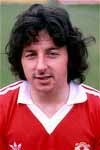
Mickey Thomas was a skilful, energetic Welsh winger who represented Manchester United between 1978 and 1981. Known for his pace, direct running and colourful personality, Thomas made 110 competitive appearances for United, scored 15 goals and appeared in the memorable 1979 FA Cup final against Arsenal.
Michael Reginald Thomas was born in Mochdre, near Colwyn Bay in North Wales, on 7 July 1954. He began playing organised football at a young age and was already appearing for a local men’s team by the time he was 13. Thomas joined Wrexham as a teenager alongside his friend and fellow future Welsh international Joey Jones. He made his senior debut during the 1971/1972 season, aged 17, and gradually established himself as an exciting left-sided attacker. Under manager John Neal, Wrexham developed a formidable reputation in cup competitions. Thomas helped the club reach the FA Cup quarter-finals in 1974 and the European Cup Winners’ Cup quarter-finals two years later, where they were narrowly eliminated by eventual winners Anderlecht.
Wrexham won the Welsh Cup in 1975 and again in 1978, while Thomas also played an important role as the club captured the Third Division championship in 1977/1978.
His performances attracted interest from several leading English clubs. Thomas later revealed that he rejected opportunities elsewhere because he wanted regular football, but the chance to join Manchester United proved impossible to refuse. Dave Sexton signed Thomas from Wrexham in November 1978 for approximately £333,333. Although naturally left-footed and most effective on the wing, his energy and versatility allowed him to operate across several attacking and midfield positions.
Thomas made his United debut on 25 November 1978 in a First Division match against Chelsea at Stamford Bridge. Jimmy Greenhoff scored the only goal as United began Thomas’s career with a 1–0 victory.
He quickly became a regular and made 33 appearances during the remainder of his first season. His speed, close control and willingness to attack defenders added an unpredictable element to United’s forward play.
Thomas scored his first United goal on 10 March 1979 in an FA Cup quarter-final against Tottenham Hotspur at White Hart Lane. With United trailing to an Osvaldo Ardiles goal, Thomas equalised during the second half to secure a 1–1 draw. United won the replay 2–0 at Old Trafford. He scored his first league goal two weeks later in a 4–1 victory over Leeds United, finishing one of United’s finest performances of the season. After defeating Liverpool in the semi-final, United faced Arsenal in the FA Cup final at Wembley on 12 May 1979. Thomas started on the left side as United attempted to recover from conceding twice during the first half.
Despite the disappointment, appearing in an FA Cup final during his first season represented a notable achievement for Thomas following his move from Third Division football. The 1979/1980 campaign was the most productive of his United career. Thomas made 40 appearances in all competitions and scored ten goals as Sexton’s side mounted a serious challenge for the First Division championship. He began the season by scoring in both legs of a League Cup tie against Tottenham Hotspur. United lost the first leg 2–1 at White Hart Lane but recovered to win the return 3–1 at Old Trafford. Thomas also converted a penalty in a 3–0 league victory away to Aston Villa and scored important goals against Leeds United, Middlesbrough and Derby County.
One of his most memorable United goals arrived in the Manchester derby on 22 March 1980. Thomas scored shortly after half-time to give United a 1–0 victory over Manchester City at Old Trafford. Two weeks later, he equalised against Liverpool before Jimmy Greenhoff scored the winner in a 2–1 victory. The result maintained United’s hopes of winning the championship.
United eventually finished second, only two points behind Liverpool. Although Thomas’s three seasons at Old Trafford did not produce a major trophy, the 1979/1980 team came extremely close to ending the club’s long wait for another league championship.
Thomas remained a regular during the early part of the 1980/1981 season. He scored on the opening day as United defeated Middlesbrough 3–0 and later found the net in an FA Cup victory over Brighton & Hove Albion. His final United goal came on 21 March 1981 in a 2–1 league victory over Ipswich Town. His last appearance followed on 4 April, when Mick Duxbury scored the only goal in a win against Crystal Palace at Old Trafford.
After United dismissed Sexton at the end of the season, new manager Ron Atkinson began reshaping the squad. Thomas joined Everton in the summer of 1981 as part of a transfer valued at approximately £450,000.
He left Manchester United with a record of 110 competitive appearances and 15 goals. His total included 90 First Division appearances and 11 league goals.
Thomas’s time at Everton proved brief. After falling out of favour, he moved to Brighton & Hove Albion later in 1981 and then joined Stoke City in August 1982.
At Stoke, Thomas rediscovered his best form. He scored regularly from the left wing, became a favourite with supporters and was named the club’s Player of the Year in 1983. He joined Chelsea in January 1984 and made an immediate impact by scoring twice on his debut. Reunited with former Wrexham manager John Neal, Thomas helped Chelsea win the Second Division championship and earn promotion to the First Division. Later spells followed with West Bromwich Albion and Derby County before Thomas moved to the United States to play indoor football with Wichita Wings. He returned to Britain in 1988 and represented Shrewsbury Town, Leeds United and Stoke City for a second time.
Thomas won Stoke’s Player of the Year award again in 1991, eight years after first receiving it. He then returned to Wrexham, where he produced one of the most celebrated moments of his long career.
On 4 January 1992, Fourth Division Wrexham faced reigning English champions Arsenal in the FA Cup third round at the Racecourse Ground. With Wrexham trailing 1–0 and only eight minutes remaining, the 37-year-old Thomas scored a spectacular free-kick past David Seaman. Steve Watkin added a second goal moments later as Wrexham completed a famous 2–1 victory in one of the greatest upsets in FA Cup history.
Thomas’s professional career ended in difficult circumstances after he was convicted for his involvement in passing counterfeit banknotes in 1993. He served part of an 18-month prison sentence before returning briefly to football with Porthmadog, where he also had a short spell as player-manager.
At international level, Thomas won 51 caps for Wales between 1976 and 1986 and scored four goals. One of his proudest moments came in May 1980, when he scored as Wales defeated England 4–1 at the Racecourse Ground.
After retiring, Thomas became a popular after-dinner speaker and worked in radio, providing analysis and commentary on Manchester United matches. His humour, openness and self-deprecating stories made him a familiar figure among supporters.
In 2019, Thomas announced that he had been diagnosed with stomach cancer. Following treatment, he later confirmed that he had been declared cancer-free.
Mickey Thomas’s career contained success, disappointment, controversy and several extraordinary moments. At Manchester United, he is remembered as a lively and talented winger who entertained supporters, contributed important goals and played in one of the most dramatic FA Cup finals ever staged.
His record of 110 appearances and 15 goals reflects a productive three-year spell at Old Trafford, while his later achievements with Wales, Stoke City, Chelsea and particularly Wrexham ensured his place as one of Welsh football’s most recognisable characters.