Debut:
09/09/1911 v Everton (H) 2-1 (League Division One)
Farewell:
Suspended from the game 20th February 1918 for life (see profile)
Passed Away:
1959
Biography
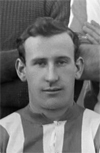
George Anderson was born in Cheetham, Manchester, in 1891. He began his football journey playing for local clubs such as Broughton St. James', Broughton Wellington, and Salford United, where his talent as a forward attracted attention. In 1910, Anderson joined Bury, but his career took a significant step forward when he signed for Manchester United in 1911.
Career at Manchester United
At Manchester United, Anderson proved himself to be a prolific forward. He was known for his sharp goal-scoring instincts and consistent performances. Over his time with the club, he made a total of 86 appearances, scoring 39 goals in official matches. During World War I, when official league competitions were suspended, Anderson continued to play in unofficial wartime matches as was routine at the time.
His contribution was crucial during a challenging period for the club, and he became a notable name among the team's pre-war players.
The 1915 Match-Fixing Scandal
George Anderson's career was overshadowed by his involvement in the infamous 1915 British football match-fixing scandal. On Good Friday, April 2, 1915, Manchester United played Liverpool in a First Division match at Old Trafford. Manchester United was struggling to avoid relegation, while Liverpool had little at stake in the league.
The match ended in a 2-0 victory for Manchester United, with Anderson scoring both goals. However, the result raised suspicions due to unusual betting patterns and the apparent lack of effort from several players. A subsequent investigation by the Football Association (FA) uncovered that players from both teams had conspired to fix the match to benefit from illegal bets placed on the specific scoreline of 2–0.
Eight players were implicated in the scandal, including Anderson. The FA found sufficient evidence to confirm his involvement and banned him from football for life. This punishment effectively ended Anderson's professional career.
Impact of the Scandal
The lifetime ban marked a tragic and abrupt conclusion to Anderson's career. The scandal tarnished his reputation and remains one of the most controversial moments in early English football history. While other players, such as Fred Pagnam, were praised for refusing to participate, Anderson's role in the conspiracy cast a shadow over his otherwise remarkable footballing achievements.
Later Life and Legacy
Following his ban, George Anderson disappeared from the public eye. His activities after leaving professional football are not well-documented. Anderson passed away in 1959, leaving behind a complex legacy as a talented footballer whose career was marred by one of English football's most notorious scandals.
Today, Anderson is remembered as both a prolific forward for Manchester United and a central figure in the 1915 match-fixing scandal. His story serves as a cautionary tale about the dangers of compromising integrity in professional sports. George Anderson was banned from Old Trafford on 08/01/1918 and sentenced to an 8-month prison term after his involvement in a match fixing scandal during the game at Old Trafford on 29/12/1917 v Burnley.