Signing Info:
Signed Trainee: 09/1963. Signed Professional: 05/1965
Previous Clubs:
Swansea City (loan), Arsenal (loan)
Debut:
15/04/1968 v Fulham (H) 3-0 (League Division One)
Farewell:
Transferred to Arsenal, 08/1974, £40,000
Passed Away:
14/08/2026 (age 78)
Biography
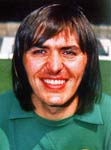
John James “Jimmy” Rimmer was an English goalkeeper who emerged through Manchester United’s youth system during the 1960s before establishing himself as a leading First Division goalkeeper with Arsenal and Aston Villa. A member of United’s 1968 European Cup-winning squad, Rimmer later won the competition again with Aston Villa in 1982, giving him a distinctive place in the history of English football.
Born in Southport, Lancashire, on 10 February 1948, Rimmer joined Manchester United as a 15-year-old schoolboy in 1963 and progressed through the club's famous youth system. He turned professional in 1965 and was part of a generation attempting to establish itself in a United side containing some of the greatest players in the club's history.
Rimmer made his competitive Manchester United debut aged 20 on 15 April 1968, keeping goal as Matt Busby's side defeated Fulham 3–0 at Old Trafford in the First Division. His arrival in the senior side came during one of the most important seasons in United's history.
Only weeks later, Manchester United faced Benfica in the 1968 European Cup Final at Wembley. Alex Stepney was firmly established as United's first-choice goalkeeper, with Rimmer named among the squad as his understudy. United defeated Benfica 4–1 after extra time to become the first English club to win the European Cup, earning the young Rimmer a European Cup winner's medal.
Breaking into the team regularly was always going to be difficult. Stepney was one of the outstanding goalkeepers of his generation and remained remarkably consistent, leaving Rimmer with limited first-team opportunities. Nevertheless, Rimmer continued to provide dependable cover and accumulated 46 competitive appearances for Manchester United.
One of the most notable matches of his United career came in the European Cup semi-final against AC Milan in April 1969. Rimmer played in the first leg at the San Siro, where United lost 2–0, before the holders were eventually eliminated 2–1 on aggregate. It demonstrated the faith placed in the young goalkeeper despite the presence of the more established Stepney.
With regular football difficult to obtain at Old Trafford, Rimmer joined Swansea City on loan in October 1973. The move provided the first sustained run of senior football he had been seeking and helped pave the way for the next stage of his career.
Rimmer left Manchester United permanently for Arsenal in 1974, the London club paying around £40,000 for his services. With Bob Wilson approaching retirement, Rimmer was given the opportunity to become an established First Division goalkeeper and quickly took advantage of it. He became Arsenal's regular number one and was voted the club's Player of the Season for 1974/75.
His performances at Highbury also brought international recognition. In 1976 Rimmer made his solitary appearance for England, representing his country against Italy. Although his international career extended to only one cap, it reflected the high regard in which he was held during his years as a first-choice top-flight goalkeeper.
In 1977 Rimmer moved to Aston Villa, where he enjoyed the greatest sustained success of his playing career. He became a central figure in the Villa side and was ever-present when the club sensationally won the First Division championship in 1980/81.
The following season produced another extraordinary European Cup triumph. Rimmer started throughout Villa's European campaign and was one of only five Villa players to start all nine of their matches in the competition. Villa reached the 1982 European Cup Final against Bayern Munich in Rotterdam, giving Rimmer the opportunity to win the trophy for a second time.
Unfortunately, the final provided one of the most bittersweet episodes of his career. Rimmer started the match but suffered a neck injury and was forced to leave the field after only nine minutes. The inexperienced Nigel Spink replaced him and produced an outstanding performance as Peter Withe's goal gave Villa a famous 1–0 victory. Rimmer nevertheless fully deserved his winner's medal after playing such an important role throughout the tournament.
It also created a remarkable coincidence. Rimmer had now collected two European Cup winner's medals, yet had completed neither final on the pitch: he had been Stepney's understudy for Manchester United at Wembley in 1968 and had been forced off injured for Aston Villa in Rotterdam 14 years later.
After leaving Villa, Rimmer returned to Swansea City in 1983, later completing his playing career after spells that also included Hamrun Spartans in Malta. He subsequently moved into coaching, including work with Swansea, and had two brief spells as the Welsh club's caretaker manager during the 1995/96 season. His coaching career also took him overseas, including work in China and Canada.
Jimmy Rimmer's time at Manchester United was largely spent in the shadow of Alex Stepney, but his subsequent career demonstrated the considerable ability he possessed. He developed from a United youngster and understudy into an England international and championship-winning goalkeeper, ultimately becoming one of Aston Villa's most celebrated players.
His career also gave him an extraordinary connection with two of English football's great European triumphs. From being part of Manchester United's historic first European Cup success in 1968 to playing a major role in Aston Villa's European Cup victory in 1982, Rimmer enjoyed achievements spanning two very different eras of the English game.