Signing Info:
Transferred from: Leeds United, 02/1978 , £495,000
Previous Clubs:
St Mirren, Leeds United
Debut:
25/02/1978 v Liverpool (A) 1-3 (League Division One)
Farewell:
Transferred to Seiko, 08/1985, £
Passed Away:
15/06/2023 (age 70)
Biography
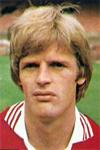
Gordon McQueen was a commanding Scottish centre-half who represented Manchester United between 1978 and 1985. Recognisable by his imposing frame and blond hair, McQueen combined physical courage and aerial dominance with a considerable goalscoring threat. He made 229 competitive appearances for United, scored 26 goals and helped the club win the 1983 FA Cup.
Born in Kilbirnie, Ayrshire, on 26 June 1952, McQueen initially played as a goalkeeper, the same position in which his father, Tom, had played professionally. He later moved into central defence and began his senior career with St Mirren after joining the club from Largs Thistle. McQueen made his St Mirren debut in 1970 and soon developed a reputation as one of the most promising young defenders in Scottish football. His performances attracted attention from several English clubs, and Leeds United signed him for approximately £30,000 in 1972.
Leeds viewed McQueen as the long-term successor to Jack Charlton. Following Charlton’s retirement, McQueen formed a powerful central-defensive partnership with Norman Hunter and became a prominent member of Don Revie’s outstanding side. During the 1973/1974 season, Leeds remained unbeaten in their opening 29 league matches and won the First Division championship. McQueen’s strength in the air, aggressive defending and ability to score from set pieces made him an important member of the title-winning team. He also played a major role in Leeds’ run to the 1975 European Cup final, scoring three goals during the competition. However, a sending-off in the semi-final against Barcelona resulted in a suspension that prevented him from appearing in the final against Bayern Munich.
By 1978, Leeds’ celebrated team was beginning to break up. Manchester United manager Dave Sexton moved to sign McQueen only weeks after purchasing his Scotland and Leeds teammate Joe Jordan. McQueen joined United in February 1978 for £495,000, a fee reported at the time as a British record for a defender. The transfer between the two fierce rivals caused considerable controversy, which McQueen intensified with his famous observation that 99 per cent of players wanted to represent Manchester United and the remainder were not telling the truth.
He made his United debut against Liverpool at Anfield on 25 February 1978. United were beaten 3–1, but McQueen quickly established himself as a first-choice centre-half and became a popular figure with the Old Trafford support. Standing six feet three inches tall, McQueen was immensely strong in the air. He attacked high balls aggressively, defended with determination and provided leadership at the back. His heading ability also made him a major attacking threat from corners and free-kicks.
McQueen’s first full season at United ended with an appearance in one of the most dramatic FA Cup finals. United faced Arsenal at Wembley on 12 May 1979 and appeared to be heading for defeat after falling two goals behind. With four minutes remaining, McQueen forced the ball into the net to reduce Arsenal’s lead. Sammy McIlroy equalised moments later, completing what appeared to be an extraordinary recovery. However, Alan Sunderland scored almost immediately at the opposite end to give Arsenal a 3–2 victory.
Although the result was a painful defeat, McQueen’s goal became one of the defining moments of a remarkable final. It also demonstrated his refusal to concede a match while any opportunity remained.
United struggled to challenge consistently for the league championship during the following seasons, but McQueen remained an important and reliable member of the defence. He was also productive in front of goal, scoring twice in a 4–0 league victory over Stoke City in September 1979.
The arrival of Ron Atkinson as manager in 1981 began a new period at Old Trafford. McQueen supplied experience alongside younger players such as Kevin Moran, Paul McGrath and Norman Whiteside, while Bryan Robson provided new leadership in midfield.
The 1982/1983 season proved to be the most successful of McQueen’s United career. He helped the team reach the finals of both major domestic cup competitions and scored several important goals during the League Cup campaign. McQueen found the net against Southampton and then scored twice in a 4–0 quarter-final victory over Nottingham Forest. United eventually met Liverpool in the League Cup final at Wembley.
An injury severely restricted McQueen during the final, but with United having already used their only permitted substitute, he remained on the pitch and was moved into attack. United led through Norman Whiteside but were eventually beaten 2–1 after extra time. Two months later, McQueen returned to Wembley for the FA Cup final against Brighton & Hove Albion. The first match ended in a 2–2 draw after extra time, with United surviving a late opportunity that could have given Brighton the trophy.
McQueen retained his place for the replay five days later. United produced a dominant performance, winning 4–0 through two goals from Bryan Robson and further strikes from Whiteside and Arnold Mühren. The victory gave McQueen the FA Cup winner’s medal that had eluded him four years earlier.
United began the following season by defeating league champions Liverpool 2–0 in the 1983 FA Charity Shield, with McQueen again appearing at the heart of the defence.
His later years at Old Trafford were increasingly disrupted by knee problems. He nevertheless continued contributing important goals, including one in a 5–1 victory over West Ham United in October 1984. McQueen’s final United goal came in a 3–0 FA Cup victory over Bournemouth on 5 January 1985. His last appearance followed one week later, when United were beaten 1–0 by Coventry City at Old Trafford.
Persistent injury prevented him from appearing again, meaning he missed United’s successful conclusion to the 1984/1985 FA Cup campaign. He left Old Trafford in August 1985 and joined Seiko in Hong Kong, where he played for one season before retiring.
McQueen completed his Manchester United career with 229 competitive appearances and 26 goals. His total included 184 First Division appearances and 20 league goals—an impressive scoring record for a central defender.
At international level, McQueen won 30 caps for Scotland between 1974 and 1981 and scored five goals. One of his most celebrated moments came at Wembley in June 1977, when his powerful header opened the scoring in Scotland’s famous 2–1 victory over England.
After retiring as a player, McQueen moved into coaching and management. He managed Airdrieonians and had a coaching spell with St Mirren before joining his former United teammate Bryan Robson at Middlesbrough. As first-team coach, he helped Middlesbrough reach several cup finals and establish themselves in the Premier League.
McQueen later worked as a scout and became a familiar television pundit, most notably with Sky Sports. His humour, direct manner and larger-than-life personality made him a popular figure with colleagues and viewers.
Gordon McQueen died at his home in North Yorkshire on 15 June 2023, just 11 days before his 71st birthday. Following his death, his family continued campaigning for greater awareness of the possible neurological effects of repeatedly heading footballs. An inquest subsequently found that repeated head impacts during his playing career were likely to have contributed to the chronic traumatic encephalopathy discovered after his death.
McQueen is remembered as one of the outstanding British centre-halves of his generation. Strong, fearless and dominant in the air, he possessed the courage and personality demanded of a Manchester United player. His 229 appearances, 26 goals and contribution to the 1983 FA Cup triumph secured his place in the club’s history.