|
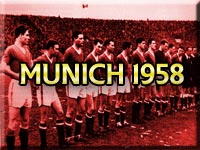
The Munich Air Disaster was a tragic event that occurred on 6 February 1958, involving British European Airways Flight 609. The aircraft, named
Lord Burghley,
was carrying a total of 44 people including Manchester United players, staff, journalists, and crew members when it crashed during takeoff at Munich-Riem Airport, West Germany.
The disaster resulted in the deaths of 23 people, including eight Manchester United players. Twenty people sadly died at the scene. The injured, some unconscious,
were taken to the nearby Rechts der Isar Hospital in Munich, where three more later died, and it remains the darkest day in the club’s history.
Background
During the
1957–58
season, Manchester United, under the management of
Sir Matt Busby,
were one of the most exciting teams in European football. Known as the "Busby Babes," the squad was young, talented, and full of promise.
They had just played a European Cup quarter-final match on
Wednesday 5th February
against
Red Star Belgrade,
securing a place in the semi-finals after a 3-3 draw.
On their way back to Manchester, the team had to refuel in Munich, as their aircraft, an "Elizabethan" Airspeed Ambassador G-ALZU, lacked the range for a non-stop flight.
The Crash
After refuelling at Munich-Riem Airport, the aircraft attempted to take off twice, but both attempts were abandoned due to engine problems.
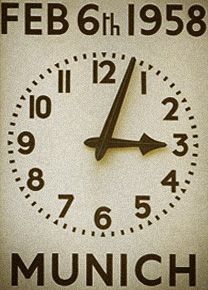
On the third attempt, at 3:04 PM, the aircraft failed to gain sufficient speed due to slush on the runway, causing it to crash through the airport fence,
across a road, before striking a house. Its port wing was torn off and the aircraft sustained severe damage, including losing its tail section,
while the cockpit struck a tree. The fuselage then hit a building containing a truck filled with tyres and fuel, which exploded into flames.
Casualties
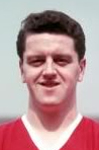
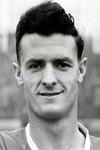
A total of 23 people lost their lives, including:
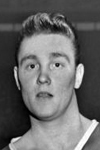
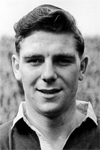
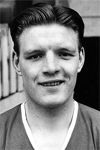
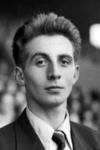
Manchester United Players (8 killed):
Geoff Bent,
Roger Byrne (Captain),
Eddie Colman,
Duncan Edwards (died 15 days later in hospital),
Mark Jones,
David Pegg,
Tommy Taylor,
Liam “Billy” Whelan.
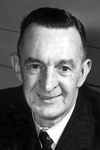
Manchester United Club Officials:
Walter Crickmer (Club Secretary),
Tom Curry (Trainer),
Bert Whalley (Coach)
Journalists (8 killed):
Alf Clarke (Manchester Evening Chronicle),
Don Davies (Manchester Guardian),
George Fellows (Daily Herald),
Tom Jackson (Manchester Evening News),
Archie Ledbrooke (Daily Mirror),
Henry Rose (Daily Express),
Eric Thompson (Daily Mail),
Frank Swift (News of the World, former England & Manchester City goalkeeper).
Crew Members & Other Passengers:
Captain Kenneth Rayment (Co-Pilot), RAF flight lieutenant and Second World War veteran,
Bela Miklos (Travel Agent),
Willie Satinoff (Club Supporter)
Survivors
Twenty-one people survived, though many were seriously injured. Among them were:
Sir Matt Busby (Manager) – suffered life-threatening injuries but recovered.
Bobby Charlton – became one of the greatest players in football history.
Bill Foulkes – played a vital role in rebuilding the club.
Harry Gregg – goalkeeper who rescued several passengers, including Bobby Charlton and a pregnant woman.
Jackie Blanchflower – survived but sustained severe injuries that ended his football career.
Johnny Berry – survived but never played football again due to injuries.
Aftermath
Manchester United, shattered by the loss, had to rebuild from scratch. Jimmy Murphy, Busby’s assistant,
took charge of the team while Busby recovered. Despite the tragedy, United made it to the FA Cup Final that season,
but lost to Bolton Wanderers.
Matt Busby returned to manage United and, a decade later, led them to European Cup glory in 1968,
fulfilling the dream that the "Busby Babes" had started.
Legacy
The Munich Air Disaster remains an integral part of Manchester United’s history. Every year, the club and its fans commemorate the tragedy with tributes,
especially at Old Trafford’s Munich clock, which is permanently stopped at 3:04 PM.
The disaster shaped Manchester United’s identity, reinforcing their resilience and inspiring future generations of players and fans.
“We’ll Never Die,” a popular United chant, remains a reminder of the fallen Busby Babes.
Fact: Liverpool FC & Manchester City FC also had connections to the tragedy.
Herbert Whalley, who lost his life in the disaster, played for Liverpool as a guest during World War II,
while Matt Busby, who was seriously injured, played for Liverpool from 1936 to 1939.
Frank Swift, who also lost his life, was a legendary goalkeeper for Manchester City and England from 1933–1949,
and also appeared for Liverpool as a wartime guest player.
Manchester United effectively lost 10 first-team players in total, as
Jackie Blanchflower
and
Johnny Berry
never played again due to their injuries sustained in the crash.
|
Manchester United Christmas Poem
Twas the night before Christmas, Old Trafford was bare.
The staff all gone home, there was nobody there.
The lights cast a shadow, a soft glimmer which
lit up the soft green grass on the pitch.
Just as the clock gave out its twelfth chime
An old man appeared, as if frozen in time.
He gazed at the tunnel, then broke out in voice
"ITS TIME TO BEGIN.. LETS HAVE YOU MY BOYS"
Then out from the tunnel appeared a lone figure
The same as in life, but infinitely bigger
The old man called out as he slowly drew near
"Good evening Duncan, are the rest of you here"
The figure broke out in wide open smile
"Good Evening Sir Matt, it has been a long while
"The rest are all coming, they'll all be here soon,"
As seven more shadows were cast by the moon.
Whelan and Bent, Pegg, Taylor and Byrne,
Jones , and Colman, they came out in turn.
He greeted each one, just by calling their name
then proudly announced "do you fancy a game"
They took to the pitch, and the still night was broken
By leather on leather, not one word was spoken
They played once again, like they did long before
And imagined the sound of the Old Trafford roar
Edwards called out "come on lets pretend"
That we've just scored a goal at the old Stretford End"
As they ran to the edge of the pitch by the goal
There in the stands sat a solitary soul.
His eyes were all puffy, his cheeks wet with tears
As his mind wandered back to those wonderful years
"come down and join us" they cried all as one
"yes come down and join them" said Matt "go on son"
The lonely man stood and with much pain he said
"I'm afraid I can't play" as you are all dead.
You are all ghosts, and I am alive
That was the price that I paid to survive"
My role was to go on and inspire the team
And finally realise Sir Matt Busbys dream
To tell of your greatness, and as I get older
I burden the weight of your life on my shoulders."
The ghost of Sir Matt then raised up his head
Giving out a loud groan, he finally said
"Bobby, You survived, that much is true
But we wouldn't be here if it wasnt for you
For you are the one who has kept us alive
That was the reason you had to survive
If you were with us, all we have would be gone
And the game that we play could no longer go on
If you can't understand why it happened this way
Then come here and watch when United play
They sing about us, they remember us all
We live and we breathe with each kick of the ball
The legends that live here, Robson and Best
Cantona, Law, Giggs, Scholes and the rest
They are us, we are them, we are all here as one
And that is the reason United goes on
So come down and join us, we're begging you do
You are still one of us, and we're still one of you"
And then Bobbys face rose and he gave them a smile
And he said "I would love to come play for a while"
They played and they played, as they did in the past
Only not quite as skilful, and not quite as fast
And when it was over, and when it was done
They'd defeated Benfica by four goals to one.
Then Sir Matt said "lads, its been fun you know
But It's now Christmas day, and we really must go"
They walked to the front of the stadium and turned
And Sir Bobby said "there is something I've learned"
"You did not die, on that February night
You're still here with us, as you're with me tonight
And you'll live on forever as long as we play
As the ghosts disappeared down Sir Matt Busby way...................
Kindly used with the permission of Mr Ian Gibson. |