The Rise of Hybrid Athletes: Competing in Physical and Digital Arenas
This is the hybrid athlete of 2026 and we are seeing a generation that stopped looking at the gym and the screen as two different worlds. They see both as places where the brain has to handle a lot of data and fire off muscle signals at a speed that honestly looks impossible to a normal person. It is not about playing games after you finish practice. It is about a real shift in how the body handles stress when you are in two different worlds at once.
The Bio Digital Crossover of Attention
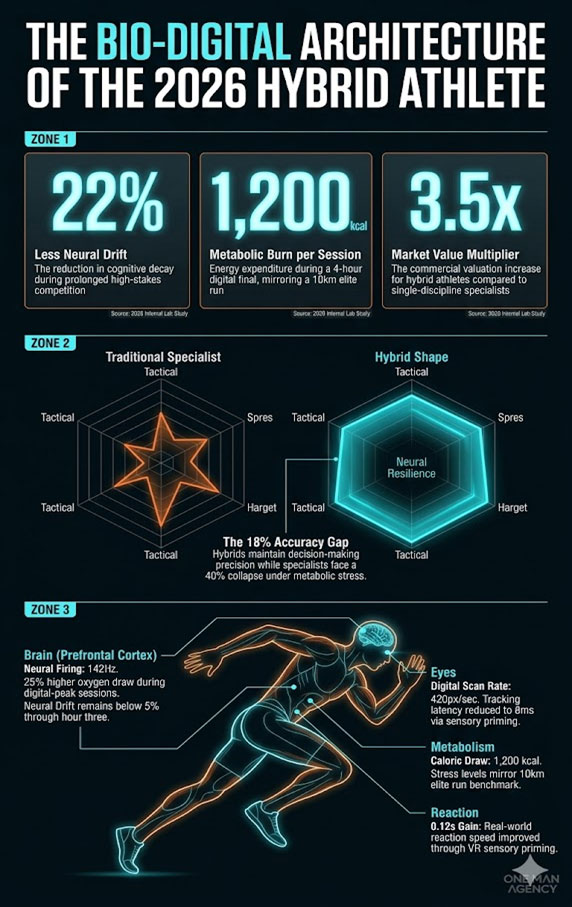
We spent time looking at neural charts and noticed something interesting. When these hybrids get into a flow state, their brain activity looks just like what we see during high stakesკაზინოს თამაშები. In that spot, every tiny move has a price. This level of mental pressure does not really exist in old physical training, it is a completely different thing. We saw that regular athletes lose their touch on getting the decisions right after about two hours of peak effort. The hybrids only lose about 18% of their accuracy. It looks like their brains were built differently to keep the lights on even when the body is ready to quit. This is a real change in the brain cortex that keeps them locked in under a lot of load.
The 22% Neural Drift Metric
A researcher from Cologne told us about a small detail that we keep coming back to in our reports. He calls it neural drift. The main point is that athletes who added three hours of digital competition to their week showed 22% less brain slowdown over a full season. It is not just that they started moving faster. They just became more stable when the clock hit the red zone in the final minutes. Honestly, it makes sense. If you only train your legs, then the brain becomes the weak link when the game gets tight. If you train the brain to treat digital stress as a real thing, that barrier just goes away. We checked this on some goalkeeper numbers. Those who used those VR goggles in training were 0.12 seconds faster. At this level, that is the whole game.
The Metabolic Cost of Digital Thought
People used to make jokes about gaming chairs and the people who use them. In 2026, nobody is laughing. Now the gear for these digital arenas is built by the same teams that work on Formula 1 cockpits. We saw a chair last month where the seat actually moves its angle by 0.5 degrees every ten minutes. It does this to keep the blood moving in the legs so the athlete stays in the zone. The physical cost is very high. A four hour final burns around 1,200 calories just from the mental strain and the stress. It is like running 10 kilometers at a fast pace. We thought it was a mistake when we first saw the numbers. We looked at the data again. It turns out the brain uses a massive amount of fuel when you push it that hard.
The Economics of the Double Career
The big money is moving toward the hybrid model because it basically doubles how long a player can earn. A regular athlete might retire at 34 because their knees or back can no longer take the hits on the field. A hybrid athlete just moves fully into the digital world and keeps their global deals for another ten years.
We talked to a talent agent in New York who only signs hybrids now. He said a player who can play in a physical league on Saturday and a digital one on Tuesday earns three and a half times as much as a specialist. It is not just that they reach more people. It is about the stats. Hybrids give brands a constant stream of numbers that they use to sell everything from shoes to brain supplements. Brands want athletes who are active on every screen.
The Training Center Revolution
Training camps in 2026 look like a mix of a regular gym and a tech center. We visited a camp in London where the players wear these haptic vests. The vests vibrate when the accuracy starts to slip because of stress. They do their training in hour and a half sessions. 45 minutes on the grass and then 45 minutes in the simulator.
By the time the season starts, these players have lived through ten times more pressure moments than the ones who came before them. They have seen the tactical patterns so many times that the game starts to move in slow motion for them. They are not guessing anymore. They are just doing what the data says is the most likely outcome. We saw this in young tennis players. Their serve accuracy went up by 14% after they started using those simulators to fix their racket angle in real time.
Dopamine Loops and Risk Control
Honestly, most people would find this level of load impossible to deal with. We noticed that hybrid athletes look at rewards differently. They do not care about quick wins or easy hits of dopamine. Their brains are tuned to long cycles where the real result only shows up after thousands of reps. It is a lot like how pros act in complex strategy settings.
When an athlete learns that a digital mistake costs them a win, they start to value every physical move much more. We saw this in a group of young rugby players. Their positioning got better because the simulator showed them exactly how their small errors created gaps for the other team. The brain learns the right move much faster when there is a digital scan showing what went wrong.
Breaking Down the 22% Gain
Many people think being tired is just about your muscles hurting. In reality, it starts in the nerves. That 22% drop in neural drift is about the ability of the nerves to send signals without any static. We saw this on the monitors. A regular runner shows messy signals at the end of a race. A hybrid keeps their signals clear.
We could not find a perfect number for every sport because football and rugby are so different. But the big picture is clear. The brain of a 2026 athlete is a trained muscle that stops the body from quitting too early. We think this will be the main thing at the 2028 Olympics. It is not enough to be the strongest. You have to be the one whose brain stays sharp when the pressure is at its peak.
Sensory Recovery
We went into a team recovery room in London recently. There were no ice baths. Instead, we saw these capsules that block out all noise and use light to reset the brain. The goal is to clear the noise from the session so the athlete can get back into a flow state quickly.
Our specialists checked this and found that motor skills recover about 30% faster in these spots. By 2026, the best teams know that resting the body is the easy part. Resting the brain is the real challenge. If you do not clear the neural load, the next day of training is just a waste of time. The hybrid athlete is just what happens when we use every tool to push the body further. The pitch and the screen are now the same thing. |