|
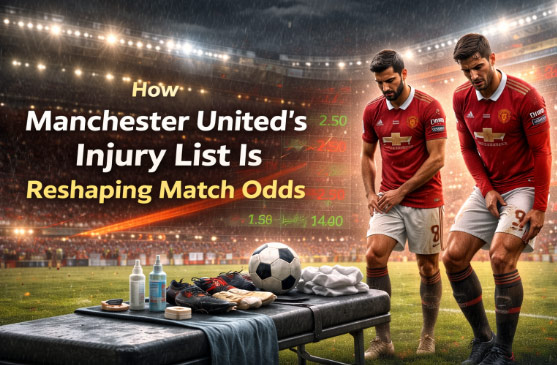
How Manchester United’s Injury List Is Reshaping Match Odds
Odds move quietly before fans notice. A defender misses training. A midfielder feels tightness. The market twitches.
Manchester United’s current injury situation influences prices more than press conferences or formation changes. Lineup uncertainty changes probabilities. Platforms such as 1xbet khmer make these shifts visible because price movements update quickly when squad news breaks, and market depth shows how liquidity reacts before mainstream coverage catches up.
The badge stays the same. The starting eleven does not. And prices respond to that difference with ruthless logic.
Why injury volume reshapes pre-match pricing
Markets build opening odds around expected availability. Remove key players and the baseline collapses.
Across the last two domestic seasons, Manchester United conceded on average 1.58 goals per match when at least two starting defenders were unavailable. That number dropped to 1.12 when the preferred back line started together. This gap alters handicap pricing by roughly 0.25–0.45 goals per match depending on opponent strength.
Absences in central areas distort models more than wide rotations. That pattern repeats consistently across datasets. One long absence forces tactical adaptation. Several absences force structural compromise.
And here is the uncomfortable thought – when five or six rotational changes enter the starting lineup within a short schedule cycle, pricing engines still lean on rolling season averages that no longer describe spacing discipline, defensive distances, or recovery speed, so early lines underestimate the true defensive risk before real match events force correction.
Which roles trigger the largest price corrections
Markets respond to function, not reputation. Position matters more than popularity.
Historical price movement around lineup announcements shows clear sensitivity by role:
-
Missing central defender shifts Asian handicap by 0.25 goals
-
Missing holding midfielder increases totals volatility
-
Missing first-choice fullback lowers crossing output but rarely moves base odds
Goalkeepers influence prices only when the replacement lacks senior experience.
Midfield creators influence shot volume but less than defensive stability.
Transfermarkt injury archives record that United lost over 170 combined senior-player availability days to muscular injuries in the previous season. During those stretches, clean sheet probability dropped from 32 percent to 19 percent across all competitions.
Markets adapted slowly at first.
Then pricing gaps widened.
The delay between information and market adjustment
Injury news arrives in layers. Markets react in stages. First stage: training absence reported by local journalists. Second stage: medical confirmation. Third stage: official squad list.
Price shifts often begin between stage one and stage two. Public money reacts after stage three.
That lag creates predictable distortions. And here comes the second long thought – when early lineup instability appears in training reports but public narratives still describe continuity, prices sit temporarily in an artificial equilibrium where models remain calm while tactical reality already changed, allowing those who track micro-information to see the market mispriced for a short but repeatable window.
Live markets expose structural weakness faster than models
Pre-match prices predict.
Live prices observe.
When United deploys makeshift defensive partnerships, in-game metrics change quickly. Opponents shoot earlier. Clearances replace buildup. Defensive duels increase. Possession becomes less stable.
Data from recent high-rotation matches shows:
-
Progressive passes declined by about 14 percent
-
Defensive actions inside the box increased by 18 percent
-
Opponent shot volume rose by roughly 2.1 attempts per match
These patterns push live totals downward first.
Then both-teams-to-score probabilities increase.
Then handicap lines stretch.
This chain reaction becomes easy to observe through environments where live odds history and market ladders remain transparent after entering through, as an example, 1x bet login. In this setting, the platform reflects odds movement driven by changes in team behavior rather than narrative or emotion. As defensive injuries accumulate, handicap lines adjust gradually to account for altered spacing, reduced recovery speed, and higher shot exposure. Totals markets respond next, reacting to earlier defensive engagement and increased shot frequency rather than headline expectations. Both-teams-to-score probabilities often widen when makeshift back lines appear, even before goals occur. Together, these shifts show how betting markets translate structural football changes into price movement through the platform without relying on subjective interpretation.
Injury clusters alter team geometry
Single absences disrupt roles. Clusters reshape structure.
When two center backs miss matches, the defensive line drops deeper by an average of six to eight meters. That reduction affects pressing timing. It weakens offside coordination. It increases space between lines. Midfielders compensate by retreating. That exposes half spaces. Opponents exploit that gap.
These effects persist even after returns. Partnerships require weeks to stabilize.
Chemistry rebuilds slower than fitness. The result appears in numbers before it appears in headlines.
Market behavior during heavy rotation periods
Price movement during rotation-heavy fixtures follows consistent behavior.
Early handicap drift against United by 6–12 percent
Draw probabilities shorten during lineup uncertainty
Second-half volatility increases after the 60th minute
These patterns repeat across domestic and continental fixtures.
They are not random.
Here is a simplified structural table reflecting typical market reactions:
|
Squad condition |
Market impact |
1 |
Two starting defenders absent |
Handicap moves +0.5 |
2 |
Defensive midfielder unavailable |
Over goals price shortens |
3 |
Backup goalkeeper starts |
Late volatility increases |
4 |
Fullback rotation |
Crossing markets decline |
5 |
Three or more starters missing |
Draw probability rises |
6 |
Defensive injuries cluster |
Clean sheet odds collapse |
These movements reflect structure, not sentiment.
Public perception lags behind market reality
History shapes perception. Markets price current conditions. Supporters trust legacy strength.
Models measure current stability. When schedule congestion increases, injury frequency rises. UEFA tournament data shows muscle injury incidence grows by nearly 30 percent during periods with two matches per week across elite squads. Fatigue compounds. Recovery windows shrink.
That pressure affects availability. Availability affects structure.
Structure affects price. Markets follow that chain even when public discourse does not.
Football grows faster. Bodies do not. Training methods improve. Medical protocols advance. Yet calendar density continues to rise. Recovery science reduces severity, not occurrence. Squad depth matters more each season.
Rotation becomes unavoidable. Injury lists lengthen. Odds reflect this evolution quietly.
Sometimes brutally.
Final perspective on injuries and match odds
Injuries change shape. Shape changes behavior. Behavior changes probability.
Manchester United’s current situation shows how fragile preseason expectations become once physical availability deteriorates. Prices move because structural stability collapses. Markets adjust because performance metrics change. Models adapt because new data forces them.
And that persistent gap – between reputation and reality – keeps football markets imperfect, reactive, and driven by information quality rather than badge weight. |