Manchester United have changed manager more times than most clubs change formation, and each appointment has arrived with promises of a new identity. Some have delivered fragments of it. None have quite managed to make it stick. When Ruben Amorim was appointed in November 2024, the Portuguese coach came with a clear system, a defined philosophy, and a reputation built on transforming Sporting CP into one of Europe's more coherent pressing sides. The question was never really whether he could coach. It was whether United's squad — assembled without a clear stylistic vision across several years of chaotic recruitment — could actually play the way he wanted.
The first season provided an uncomfortable answer. United finished 15th in the Premier League, their lowest placing in the modern era, a result reflecting structural problems inherited across several regimes. The 2025-26 campaign, with a summer of recruitment shaped around the manager's specific needs, has told a different story — not one of transformation complete, but of a club with a coherent direction for the first time in years.
The Formation: What a 3-4-2-1 Actually Means in Practice
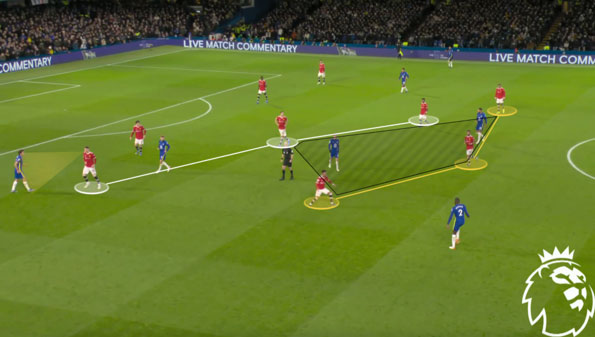
Amorim arrived with his system non-negotiable. The 3-4-2-1 — three centre-backs, two pivot midfielders, two wing-backs who function essentially as wide midfielders, two attacking players in the half-spaces behind the striker — is the structure he built his reputation on at Sporting and the one he has been determined to make work at Old Trafford.
For supporters used to conventional Premier League shapes, the formation looked unfamiliar. For some of United's existing players, it was genuinely disorienting. The system requires wing-backs with exceptional athletic capacity — they must defend deep and attack high, covering the full length of the pitch repeatedly across 90 minutes. It requires centre-backs who are comfortable in possession, capable of driving forward with the ball and picking passes through pressure. And it requires the two players in behind the striker to be intelligent movers rather than conventional wide forwards, finding pockets of space between opposition lines rather than running in channels.
In a way, the transition period felt a bit like stepping into a high-risk betting environment without a clear safety net — similar to chasing a Wanted Win no deposit style bonus in online gaming, where expectations of quick returns are high, but the underlying structure still needs time and strategy to actually deliver results.
None of those requirements matched what United's 2024 squad had been built around. The friction was visible throughout that first season: pressing disjointed, wing-backs too static in attack or too exposed in defence, and central defenders uncertain when to step forward and when to hold. Amorim was fitting square pieces into a triangular board, and the results reflected it.
The Recruitment Response
The summer of 2025 was where the project either became credible or collapsed. The players United signed suggested a front office finally working from a coherent brief. Bryan Mbeumo arrived from Brentford as a player who combines directness with an ability to operate in tight spaces, capable of functioning as either the wide attacker or the pressing forward that Amorim's system demands. Matheus Cunha, who had been one of the Premier League's most energetic and unpredictable forwards at Wolverhampton, brought exactly the kind of dynamic, off-script movement that the system's number nine role requires. Benjamin Sesko provided a more conventional centre-forward option with physicality and aerial presence.
The difference between this recruitment and what had preceded it was specificity. United had spent years signing technically talented players without obvious clarity about how they would fit together. Mbeumo, Cunha, and Sesko each addressed something the system specifically needed — pace in behind, pressing intensity, and a focal point. The results in the early weeks of 2025-26 were still inconsistent, but they looked like a team playing the same game rather than eleven individuals improvising around each other.
Build-Up Play: Where the System Creates and Where It Struggles
In possession, Amorim's system is built around vertical passing and line-breaking rather than patient circulation. The central centre-back is encouraged to invert — stepping into midfield to create a passing option and draw opponents out of their defensive shape. The wing-backs push high simultaneously, stretching the opposition horizontally and opening central lanes. The two attacking midfielders behind the striker look to receive in the spaces created by that movement.
When it works, the effect is difficult to defend against. Attacks develop quickly before defences can reorganise, wing-backs' positions force opposition wide players back, and central lanes open up. United's win at Anfield in 2025-26 — built on a fast break and then disciplined defensive shape — showed what the system produces when pressing and transition click together.
When it breaks down, the problems are structural. If the wing-backs cannot win their individual duels or make their runs at the right time, the attack becomes predictable. The two central midfielders — typically Manuel Ugarte and one other — cover enormous distances and are essential to both defensive shape and build-up recycling. When United concede the ball high up the pitch, the three-man defence can be exposed on the counter if the midfield pivot has pushed too far forward. Amorim himself acknowledged this tension after the Newcastle win in December 2025, explaining that his wing-backs had been asked to function essentially as additional defenders in the second half to protect a narrow lead.
Pressing: The Ambition and the Gap
Pressing is central to Amorim's identity as a coach. At Sporting, his teams pressed with intensity and coordination, winning the ball back high and converting turnovers into immediate attacks. The principle has been visible at United, but the execution has been inconsistent.
The gap between ambition and reality comes down to collective organisation. Effective high pressing requires every player to understand their trigger — when the press is on and the team commits simultaneously. When United pressed well, as against Arsenal in August 2025, wing-backs pinned centre-backs while forwards cut passing lanes. When mistimed, it left central spaces that intelligent teams exploited.
The improvement through the 2025-26 season has been gradual but discernible. Amorim's training methods emphasise repetition of pressing patterns until they become instinctive rather than instructed, and the evidence from results in the second half of the season suggests those patterns are taking hold more consistently. The loss to Brentford early in the campaign, which came from exactly the kind of disorganised pressing that had plagued the first season, looks like an aberration against a run of more defensively compact performances.
The Players Who Define the System
Any tactical system is only as coherent as the players best suited to it. Patrick Dorgu, the Danish wing-back signed in January 2025, has emerged as one of the system's most convincing outputs — a powerful runner who covers ground efficiently, combines in central areas, and tracks back without disrupting defensive recovery.
Matheus Cunha has been the team's most important attacking player, not because he is the most gifted technically but because he functions as the connective tissue the system needs. His willingness to press from the front, drop into midfield to receive and play forward, and make runs into channels that drag defenders out of position makes everything around him more effective. Amorim singled him out after the Newcastle game precisely because Cunha's movement was the thing that allowed United to breathe in a difficult second half.
Mason Mount, whose United career had been devastated by injury, has found a role as the left-sided attacker behind the striker — a position that uses his technical quality in tight spaces without demanding the physical intensity that has repeatedly broken him down.
What Has Changed and What Remains to Be Done
The honest assessment of Manchester United under Amorim is of a rebuild that is real but incomplete. The tactical identity is clearer than at any point since Sir Alex Ferguson's final years. The recruitment has become more coherent. The performances, while still variable, show evidence of a team responding to consistent coaching rather than constantly improvising.
What has not yet changed is the margin for error. When United are well-organised and in their rhythm, the system produces results against strong opponents. When individual errors disrupt the structure — a wing-back caught upfield, a pressing trigger missed in midfield, a goalkeeper mistake as happened against Arsenal — the system's exposed shape can be punished quickly. Amorim's teams at Sporting were built over multiple seasons and had the benefit of players developed specifically within his methodology. United's squad is still partway through that adaptation.
The trajectory, though, points upward. Finishing 15th in the first season was a nadir that reflected the true state of a squad in disarray. The 2025-26 season, with a win at Anfield, competitive performances against top-half sides, and a group of players who are beginning to understand what is being asked of them, looks like what the beginning of something actually building tends to look like. Whether it leads where United's supporters want it to go depends on patience, sustained recruitment discipline, and time — three things the club has not always managed to provide its managers. |