The Influence of Global Trends on Entertainment and Sports in Indonesia
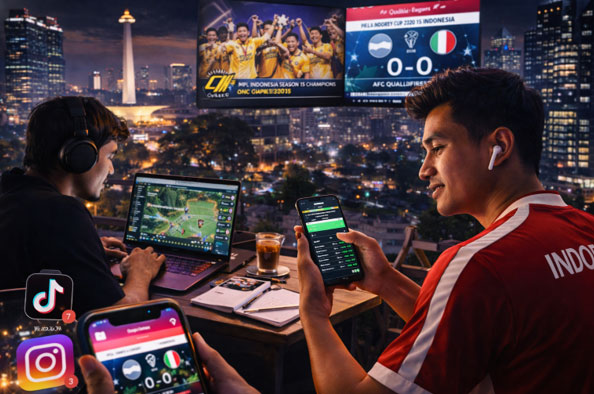
Indonesia’s digital entertainment market in 2026 looks less like a set of separate products and more like one connected loop. DataReportal says the country had 331 million mobile connections, 230 million internet users, and 180 million social media user identities in late 2025, while BPS reported that 72.78 percent of Indonesians had accessed the internet in 2024 and 68.65 percent used a mobile cellular phone. Those numbers show up in ordinary routines: a commuter watches a Liga match clip before work, checks a push alert at lunch, and finishes the day with a game stream, a chat thread, and a score app open at the same time. The phone decides.
One screen became three
Sport is still the clearest entry point. On March 25, 2025, Indonesia beat Bahrain 1-0 at Gelora Bung Karno, and the AFC said the result took Patrick Kluivert’s side to nine points with two matches left in the final round of qualifying; one moment in Jakarta became thousands of clips, stat cards, and argument threads within minutes. That is why the MelBet app sits naturally inside the same routine as live scores and highlight feeds: a fan already tracking line movement, possession swings, and probable outcomes during a tight qualifier does not treat sports-related probability content as separate from entertainment. The same user who watches Ole Romeny’s winner in the 24th minute also wants immediate data, faster navigation, and a way to act on the match before the tempo changes.
Broadcast rights now shape habits
Global media logic has moved straight into Indonesian living rooms and cafés. TVRI secured the 2026 FIFA World Cup broadcast package in Indonesia, and reporting in late December 2025 said the public broadcaster would air all 104 matches across the 39-day tournament, with live broadcasts, delayed showings, and reruns built into the schedule. That matters because sports consumption is now being designed around repetition and return: the user catches one half on television, rewatches a goal on a phone, then moves to social clips and commentary after midnight. The event is still the event, but the feed now carries it longer than the stadium ever could.
Mobile gaming stopped waiting for its turn
Esports follows the same pattern, only faster. Moonton’s official recap says ONIC beat RRQ Hoshi to win MPL Indonesia Season 15 on June 15, 2025, a final that mattered well beyond the arena because it fed a national habit of watching Mobile Legends in short bursts on YouTube, TikTok, Facebook Gaming, and other live platforms before dropping back into chat and ranked play. In that digital context, Pendaftaran MelBet belongs in the same ecosystem as game onboarding, because users now expect a short path from curiosity to account setup, whether the destination is a tournament stream, a fantasy-style data service, or a sports-probability platform. One small observation has become hard to miss in Indonesia: the strongest products no longer ask for a dedicated evening, only for thirty seconds of attention at the right time.
Participation got faster
What changed most is not access but behavior. DataReportal notes that Indonesia’s digital 2026 data reflects the latest available figures from October 2025, and those figures show a country where 60 percent of the population lived in urban centers, LinkedIn alone counted 37 million members, and major social platforms had already become distribution systems for live reaction, fan edits, and second-screen discussion. That means users no longer just consume sports and gaming; they annotate them, clip them, repost them, and fold them into group chats before the formal recap is even written. Speed wins.
Convenience became the real benchmark
The practical side of entertainment now matters as much as the content itself. BPS says 18.52 percent of households owned a computer in 2024, which is enough to keep laptop streaming, remote work, and desktop gaming alive, but the national pattern is clearly mobile-first because the handset is the device that travels with the user from work to transport to leisure. That is where Aplikasi Melbet fits the broader market story: it competes not only with other sports products but with ride-hailing apps, wallets, short-video feeds, and live-stream tools that have trained Indonesians to expect instant load times, clean menus, and resumed sessions after interruption. A probability-based platform that feels slow now loses to a football reel, a Mobile Legends stream, or a payment app in a single swipe.
The ecosystem is the entertainment
By 2026, Indonesian digital entertainment will no longer be divided neatly into sports, gaming, streaming, and social media. A World Cup qualifier, an MPL final, and a late-night short-video session now belong to the same continuous cycle of alerts, live data, user participation, and reopened apps, and the products that thrive are the ones that understand that continuity. One small observation from the past year says a lot: the biggest moments are no longer finished when the whistle blows, or the series ends, because the real afterlife begins in clips, odds, chat threads, and replay screens that keep moving after the official event is over. That is the modern entertainment system in Indonesia: one device, several rhythms, no clean border between watching, playing, and reacting. |