|
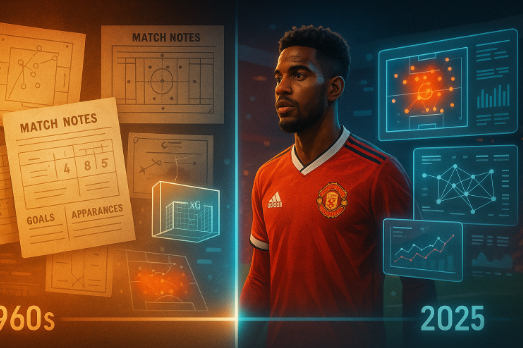
Football analytics has undergone a revolutionary transformation over the past six decades, evolving from rudimentary match reports and basic goal tallies into a sophisticated ecosystem of advanced metrics, machine learning models, and real-time performance tracking. Manchester United, as one of the world's most scrutinised clubs, has found itself at the centre of this analytical revolution – not merely as a subject of professional data science, but as the focal point of a thriving statistical culture that spans professional analysts, journalists, and an increasingly data-literate fanbase.
The democratisation of football data has fundamentally altered how supporters engage with the sport. Where previous generations relied on newspaper match reports and televised highlights, today's fans access granular performance metrics with the same ease they might check the weather forecast. This shift has profound implications for how players are perceived, discussed, and ultimately valued within the Manchester United ecosystem.
1960s–1980s: The Era of Observable Metrics
During the golden years of Sir Matt Busby and into the early Ferguson era, player assessment relied almost entirely on what could be easily observed and recorded: appearances, goals scored, assists (though inconsistently tracked), and tackles won. The 1968 European Cup triumph, for instance, was celebrated through narratives of individual brilliance – Bobby Charlton's elegance, George Best's dribbling wizardry, Nobby Stiles's tenacity – rather than quantifiable performance indicators.
Press coverage during this period reflected the limitations of available data. Match reports in publications like The Guardian or The Times focused on subjective observations: a player's work rate, positional discipline, or mental fortitude. When Denis Law scored 237 goals for United, that figure alone became his statistical legacy, with little consideration for shot quality, creative contribution, or defensive work rate.
Legends such as Bryan Robson earned their reputations through visible impact – crucial goals in important matches, lung-busting runs from box to box, leadership during adversity. Yet the absence of comprehensive data meant that many aspects of their game remained unquantified. Was Robson truly elite at progressive ball carrying compared to contemporaries? Did his pressing frequency exceed league averages? These questions simply couldn't be answered with the tools available.
1990s–2010s: Systematising Football Data
The establishment of Opta Sports in 1996 marked a watershed moment for football analytics. For the first time, matches were being recorded with systematic rigour, capturing not just goals and assists but passes completed, tackles attempted, interceptions, and aerial duels. Manchester United's treble-winning season of 1998-99 coincided with this data revolution, though the numbers would only be fully appreciated retrospectively.
Sir Alex Ferguson, despite his reputation for old-school management, was an early adopter of performance analysis technology. United invested in video analysis systems and began tracking opposition tendencies, though the statistical framework remained relatively basic by modern standards. The emphasis was on possession percentages, territorial dominance, and shot volume – metrics that told part of the story but lacked contextual sophistication.
The real paradigm shift arrived with Expected Goals (xG), a metric that emerged from academic research in the early 2010s and quickly gained mainstream traction. Rather than treating all shots equally, xG assigned probability values based on factors such as distance, angle, assist type, and defensive pressure. This single innovation transformed player assessment overnight.
Suddenly, Wayne Rooney's value extended beyond his goal tally to encompass his shot quality generation. Strikers who appeared prolific might be exposed as fortunate finishers benefiting from high-quality chances, whilst forwards with modest goal returns could be vindicated by excellent underlying numbers. The metric spread rapidly: Expected Assists (xA), Expected Goals Chain (xGChain), and Expected Goals Buildup (xGBuildup) followed, each adding layers of nuance to performance evaluation.
For Manchester United specifically, these metrics proved revelatory during the club's post-Ferguson struggles. Louis van Gaal's possession-heavy approach produced impressive ball retention statistics but anaemic xG figures – the team controlled matches without creating genuine danger. José Mourinho's tenure could be dissected through defensive metrics: Passes Allowed Per Defensive Action (PPDA) revealed United's mid-block defending philosophy, whilst progressive carries highlighted the team's reliance on counter-attacking transitions.
The New Wave: Pressing Actions, Zones, and Dynamic Metrics
Contemporary football analytics has evolved into a discipline rivalling professional sports science in complexity. The modern analyst doesn't merely count events but maps spatial relationships, temporal patterns, and contextual dependencies. For Manchester United supporters and analysts, this sophistication has opened unprecedented windows into tactical nuances previously visible only to coaching staff.
Pressing metrics have become particularly significant in the post-Mourinho era. Under Ole Gunnar Solskjær and subsequently Erik ten Hag, United's pressing strategy underwent radical transformation. Metrics such as:
-
PPDA (Passes Allowed Per Defensive Action): Measuring defensive intensity
-
Pressing success rate: Percentage of presses resulting in ball recovery within five seconds
-
Counter-pressing efficiency: Ball recoveries within three seconds of possession loss
-
Pressing triggers: Specific opposition actions (back passes, wide positions, specific player targets) that initiate coordinated pressure
These metrics revealed uncomfortable truths during Solskjær's tenure – United's pressing was sporadic rather than systematic, with wide variations between players. Bruno Fernandes consistently ranked among the league's most active pressers, whilst certain teammates operated in markedly different intensity zones.
Progressive actions have similarly revolutionised midfield and defensive assessment. Progressive passes (advancing the ball at least 10 metres toward the opponent's goal) and progressive carries (dribbles moving the ball forward at least 5 metres) illuminate players' ability to break defensive lines. Casemiro's arrival in 2022 exemplified this analytical approach – his progressive passing percentile ranked in the mid-80s across Europe's top five leagues, justifying United's substantial investment in a player traditionalists might have dismissed as a defensive specialist approaching 31.
Zone-based analysis has transformed defensive evaluation. Rather than crude tackle and interception counts, analysts now examine defensive actions across pitch thirds, heat maps showing positional discipline, and shield effectiveness (preventing opposition access to dangerous areas). Harry Maguire's rehabilitation in public perception owed partly to zone-based metrics demonstrating his effectiveness in aerial duels and interceptions within United's penalty area, even as his struggles in high defensive lines and isolated situations remained evident.
The Expansion of Fan-Driven Analytical Platforms
Perhaps the most significant development in football analytics hasn't occurred within professional clubs but across the decentralised network of fan-created platforms, Twitter accounts, and independent websites. Manchester United's global fanbase has spawned a remarkable analytical subculture, with supporters producing sophisticated content that occasionally rivals professional analysis in depth and insight.
Platforms such as StatsBomb, Wyscout, and FBref have democratised access to advanced metrics previously guarded by clubs. Meanwhile, individual content creators leverage these tools to produce visualisations and analyses tailored specifically to United:
-
Passing networks illustrating tactical relationships between players during specific matches
-
Shot maps with xG values overlaid, revealing patterns in chance creation
-
Heat maps tracking individual player positioning across multiple matches
-
Defensive action maps showing where tackles, interceptions, and blocks occur
-
Progressive action charts highlighting which players drive the team forward
This fan-generated content serves multiple functions. It provides tactical education for supporters seeking deeper understanding, offers evidence-based arguments in online debates, and occasionally influences mainstream media narratives. When a player like Scott McTominay faces criticism, sophisticated fans counter with progressive pass metrics, defensive duel success rates, and contextual information about tactical instructions – transforming discussions that might once have relied purely on subjective impression.
The quality ceiling for fan analysis has risen remarkably. Individual creators now produce video breakdowns incorporating StatsBomb's freeze-frame data, multi-angle replays showing off-ball movement, and statistical comparisons placing United's players within league-wide contexts. This represents a fundamental democratisation of expertise – no longer do supporters rely entirely on professional pundits whose analysis may lack statistical grounding.
The Digital Ecosystem Surrounding Football and Online Fan Behaviour
Manchester United supporters don't engage with football analytics in isolation. They navigate a complex digital ecosystem encompassing social media platforms, streaming services, forum communities, fantasy football applications, and various entertainment services. This interconnected online environment shapes how fans consume, discuss, and interact with football content.
The typical contemporary United supporter might begin their matchday by checking FBref for opposition statistics, move to Twitter to review tactical preview threads, watch the match via streaming services, then immediately engage in post-match discussion across Reddit's r/reddevils, Discord servers, and WhatsApp groups – often whilst simultaneously consulting live statistics on platforms like Sofascore or FotMob.
This multi-platform engagement reflects broader digitalisation trends. The same technological infrastructure and user behavioural patterns that support football analytics platforms have enabled growth across numerous online services. The digital entertainment landscape has expanded to include various options, from streaming services and gaming platforms to alternative entertainment avenues. This includes the emergence of accessible online gaming services such as £5 deposit casinos not on GamStop, which operate within the same digital ecosystem where supporters engage with match analysis, statistical platforms, and football discussion communities. Fans frequently navigate multiple digital services simultaneously, reflecting how entertainment and information consumption has become increasingly fragmented and platform-agnostic.
This ecosystem effect matters for understanding modern football culture. Analytical engagement doesn't exist in a vacuum – it's one behaviour among many in supporters' digital lives. The skills fans develop navigating statistical platforms (interpreting data visualisations, understanding probabilistic thinking, evaluating evidence quality) transfer across their online activities.
Moreover, the community aspect of digital engagement reinforces analytical literacy. Supporters who might feel intimidated by xG models find them explained repeatedly across social platforms, gradually absorbing concepts through cultural osmosis. The meme-ification of football statistics (jokes about "per 90" metrics, xG overperformance luck running out) paradoxically aids comprehension by making analytical concepts culturally relevant and accessible.
Impact of Advanced Statistics on Manchester United Player Perception
The analytical revolution has tangibly altered public discourse surrounding specific Manchester United players, sometimes vindicating underpraised contributors and other times exposing limitations that traditional metrics obscured.
Marcus Rashford provides a compelling case study. During his difficult 2021-22 season, traditional statistics painted a bleak picture: just five goals across all competitions, a catastrophic return for an attacking player. However, analytical defenders highlighted mitigating factors – his xG (8.7) suggested significant finishing underperformance likely to regress to mean, his progressive carries remained robust, and his defensive work rate had increased substantially under Ralf Rangnick's pressing system. When Rashford exploded for 30 goals the following season, analytical optimists claimed vindication: the underlying metrics had indicated quality that finishing variance temporarily obscured.
Fred represents another fascinating example. The Brazilian midfielder suffered sustained criticism from sections of United's fanbase who focused on passing errors and perceived carelessness. Yet advanced metrics told a more nuanced story: Fred consistently ranked highly for ball recoveries in the middle third, his pressing intensity metrics placed him among the Premier League elite, and his progressive pass attempt rate suggested a player willing to attempt difficult, line-breaking balls that inevitably carried higher turnover risk. This analytical defence didn't eliminate criticism but added essential context – Fred's profile resembled a specific archetype (high-energy disruptor) rather than a failed technical midfielder.
Conversely, some players have faced harsher scrutiny through analytical lenses. Anthony Martial's injury-plagued United career included periods of decent goal returns that masked concerning underlying numbers. His pressing metrics consistently ranked among the team's lowest, his shots per 90 declined over time, and his xG per shot suggested shot selection issues. Analytics transformed the discourse from "inconsistent but talented" to "fundamentally unsuited to high-intensity tactical systems."
Defensive players particularly benefit from analytical vindication. Victor Lindelöf exemplifies this – his lack of physical imposingness and occasional high-profile errors created a perception of inadequacy. Yet zone-based defensive metrics, passing networks showing his role in buildup, and duel success rates in specific scenarios (particularly against technically skilled attackers) revealed a more capable player than reputation suggested. Similarly, Lisandro Martínez's 2022 arrival faced immediate scepticism about his height for Premier League defending, criticism that sophisticated analysis of his Ajax metrics (aerial duel positioning, anticipatory defending, progressive passing from deep) suggested was overblown.
The phenomenon of xG overperformance has particularly influenced striker evaluation. When a forward significantly outperforms their xG over extended periods, two interpretations emerge: elite finishing ability (Cristiano Ronaldo, Erling Haaland) or unsustainable luck likely to correct. Analysts increasingly use multi-season xG data to distinguish between these possibilities, adding statistical rigour to debates about striker quality and transfer value.
AI Analytics, Predictive Modelling, and Fan Tools
The next frontier in football analytics will likely be defined by artificial intelligence and machine learning applications that transcend current statistical frameworks. Several developments appear imminent:
Predictive performance modelling already exists in rudimentary forms – tracking systems that estimate future player output based on current metrics, age curves, and historical comparisons. These will grow exponentially more sophisticated, potentially predicting individual match performance based on opponent characteristics, recent training data, and even environmental factors like travel demands or weather conditions.
Injury prediction models represent perhaps the highest-value analytical frontier. If algorithms could reliably identify injury risk based on movement patterns, workload data, and biomechanical analysis, the financial implications would be enormous. Manchester United's injury crisis during the 2023-24 season – with Lisandro Martínez, Casemiro, Mason Mount, and others suffering extended absences – illustrated the catastrophic impact of medical misfortune. Predictive analytics might mitigate such issues through adjusted training loads and rotation policies informed by risk algorithms.
Automated tactical recognition will transform match analysis. Rather than human analysts laboriously tagging pressing triggers and defensive shapes, computer vision systems will automatically identify tactical patterns across thousands of matches, creating vast comparative databases. United's coaching staff could instantly query: "Show all instances where a team playing a 4-2-3-1 successfully progressed through Liverpool's press in the past two seasons," receiving tagged video examples within seconds.
Fan-accessible AI tools will democratise sophisticated analysis further. Imagine applications allowing supporters to upload match footage and receive automated tactical breakdowns, passing network diagrams, and xG maps – analysis currently requiring hours of manual work delivered instantaneously. Some platforms are developing these capabilities now; within five years, they'll likely be standard features of football consumption.
Natural language processing applied to scout reports, coaching notes, and match commentary could extract tactical insights at scale impossible through manual analysis. An AI trained on decades of football writing might identify subtle tactical trends, linguistic patterns surrounding player types, and historical precedents for current situations with superhuman comprehensiveness.
For Manchester United specifically, these technologies may influence everything from recruitment (algorithms identifying statistically undervalued targets) to match preparation (automated opposition analysis) to fan engagement (personalised statistical content based on individual supporter preferences). The boundary between professional and amateur analysis will continue blurring as tools become more accessible and intuitive.
What We’ll Have in the Future
Football analytics has evolved from marginal novelty to central component of how Manchester United – the institution and the global community surrounding it – understands player performance. What began as basic goal tallies and appearance counts has blossomed into a sophisticated analytical ecosystem encompassing expected goals models, pressing metrics, zone-based defensive analysis, progressive action tracking, and increasingly, predictive AI applications.
This transformation reflects not merely technical advancement but cultural change. Today's Manchester United supporter is statistically literate in ways previous generations couldn't imagine, fluently discussing xG overperformance, PPDA figures, and progressive carry percentages. This analytical fluency influences everything from transfer speculation to matchday discourse to player reputation.
The democratisation of football data – through platforms like FBref, StatsBomb, and countless fan-created analytical accounts – has fundamentally altered the power dynamics of football expertise. Supporters no longer rely exclusively on professional pundits or club-affiliated sources; they generate their own insights, often with comparable sophistication. This fan-driven analytical culture has become inseparable from Manchester United's identity, a defining characteristic of what it means to support the club in the digital age.
The broader digital ecosystem surrounding football has amplified these trends. As supporters navigate multiple online platforms simultaneously – statistical services, social media, streaming applications, and various entertainment options – analytical thinking becomes woven into their general digital literacy. The skills required to interpret xG models or evaluate pressing metrics transfer across their online activities, creating a generation of supporters comfortable with data-driven decision making.
Looking forward, artificial intelligence and machine learning will push football analytics into territories barely imaginable a decade ago. Predictive models, automated tactical recognition, and injury forecasting will reshape professional football operations whilst fan-accessible tools democratise sophisticated analysis further still. Through all these changes, one constant remains: every player who pulls on Manchester United's red shirt will be evaluated not merely through the eye test or traditional statistics, but through an ever-expanding array of metrics designed to capture football's beautiful complexity with increasing precision.
The transformation of football analytics has permanently altered how we perceive, discuss, and understand Manchester United's players – and the revolution has only just begun. |