 |
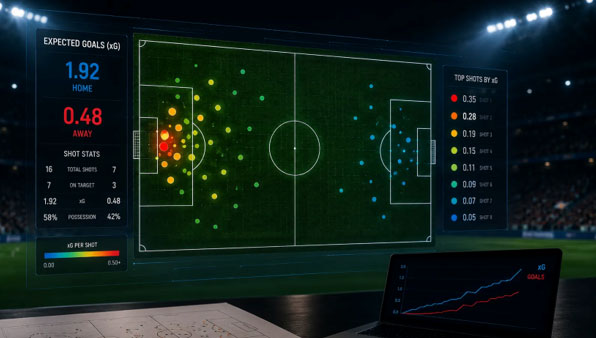
Expected goals, abbreviated to xG, has moved from an advanced analytics curiosity to a mainstream football metric in the space of a decade. What began as a tool used by analysts at the cutting edge of sports science is now regularly cited in mainstream football broadcasts, club technical departments, and increasingly by serious football bettors who have recognised its superiority over simple goals scored and conceded as a measure of underlying team quality.
The concept is elegant. Every shot in a football match can be assigned a probability of resulting in a goal based on historical data about similar shots. A tap-in from three yards in the centre of the goal has a very high xG value, perhaps 0.80 or higher, because that type of chance is converted eight times out of ten historically. A long-range effort from outside the box at an angle has a very low xG value, perhaps 0.03, because chances from that position score roughly three times in every hundred attempts. Summing these values across all the shots in a match gives a total xG for each team that reflects how many goals the quality of their chances deserved.
For bettors using Football Tips from platforms like free tips at Football Tips Hub, xG data provides a crucial cross-reference for assessing whether current results accurately reflect a team's quality or whether they are over- or underperforming their underlying level. Free Football Tips that incorporate xG alongside standard form data give a more complete and more accurate probability assessment than those based only on goals scored and conceded.
Why xG Is More Predictive Than Goals
The reason xG outperforms goals scored and conceded as a predictive metric is that goals are significantly influenced by short-term variance. A goalkeeper can make two extraordinary saves in a match that would statistically produce one conceded goal in most other games. A striker can miscontrol an open goal opportunity that almost any other forward would convert. These individual moments create scorelines that do not accurately reflect the quality of play, and models based on those scorelines consequently make prediction errors that xG-based models avoid.
Regression to the Mean
The practical implication of xG's predictive superiority is the concept of regression to the mean. A team significantly outperforming their xG total through very high conversion rates and exceptional goalkeeping will, over time, revert toward the goal total their xG predicts. Identifying teams in this overperforming state before the regression happens is one of the clearest value opportunities that xG analysis provides. Backing their opponents at longer prices than their recent results would justify can produce systematic value when the market has not yet recognised the unsustainable nature of the current performance.
Teams With High xG Against That Remain Lucky
The reverse situation, a team whose defence is allowing high-quality chances but conceding far fewer goals than their xGA suggests because of exceptional goalkeeping, is equally important. When the market prices this team as a defensive unit based on their clean sheet record rather than their underlying concession quality, future opponents may be underpriced because the defensive luck is not sustainable.
Practical Application in Goals Markets
xG is most directly applicable to goals markets because it measures the expected volume of high-quality scoring opportunities in each match. A fixture between two teams with consistently high xG for and against metrics is a strong over goals candidate because both sides create and allow genuinely dangerous chances at a high rate. A match between two teams with low xG for metrics is a natural under goods candidate because neither side generates consistent quality in attack.
Combining xG With Defensive Line Data
Teams that defend with a high line and press aggressively allow more xG against than those that defend deep, because high defensive lines create spaces in behind that produce high-value counter-attacking chances. Identifying fixtures where one team's aggressive pressing approach will expose a high defensive line to quality counter-attacks gives xG analysis an additional tactical dimension that pure shot-based models do not capture.
Conclusion
Expected goals is genuinely one of the most useful analytical tools available to football bettors because it separates underlying performance quality from short-term results variance. Learning to use it alongside standard form data produces more accurate probability assessments, clearer goals market decisions, and a better long-term foundation for value identification than traditional statistics alone provide. |